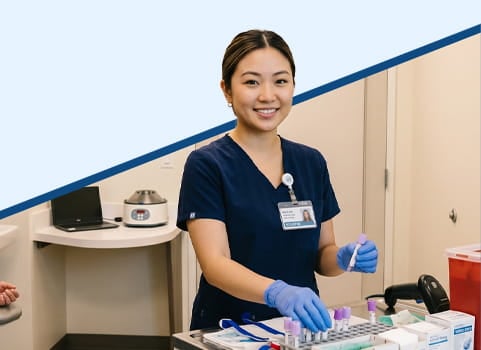
Phlebotomy Training for Working Adults: Best Options in 2026

We follow strict quality and ethics policies to make sure our content is honest, accurate, and helpful. Learn more about our editorial guidelines.
Often, the best options for phlebotomy training for working adults are self-paced, online programs that allow you to study around your job, then complete a short hands-on externship. Through programs like these, you can take the first steps toward a new career without having to sacrifice hours at work or time with your family and friends. But not every program will be the right fit, so it’s helpful to explore your options to find the phlebotomy training that works best for you, your life, and your goals.
Key Takeaways
- The Bureau of Labor Statistics (BLS) reports a median annual pay of $43,660 for phlebotomists, with about 18,400 job openings projected each year over the next decade.*
- Self-paced online programs let you study around shifts at work, childcare, or a second job, since there are no set class times.
- Most programs require a hands-on externship of 40 hours or more, even if the coursework is online, so full remote learning isn't entirely possible for this career.
What is phlebotomy training and why does it matter?
Phlebotomy training teaches you how to draw blood safely from patients. You learn anatomy, infection control, how to talk to nervous patients, and how to handle blood samples so labs get accurate results.
Getting the right training as a future phlebotomy technician is important because, not only does it help you prepare for a new job, it gives you the knowledge and confidence to keep patients safe. It’s also a fairly quick path toward starting a career in healthcare, especially if you don’t have previous experience in medical roles. Besides learning new skills, the right training program can also help you prepare to sit for important industry certification that employers often look for, giving you a credential that can help you qualify for entry-level jobs in the field. But with a few different types of program out there, how do you decide which is the right fit for you?
For a closer look at what a day in this job looks like and what skills matter most, our phlebotomy technician career guide breaks down what you need to know!
Types of phlebotomy training: online, hybrid, and in-person
Not all phlebotomy programs are the same, so when you’re choosing the right fit for you, you want to consider things like how flexible your schedule is, your budget, and how you learn best.
Online, self-paced phlebotomy technician training
Online programs tend to offer asynchronous classes. You learn on your own schedule, with no set login times or deadlines. You'll often practice clinical skills through simulations and practice kits at home, building your confidence before you start to work with real people!
Online phlebotomy classes can be a great fit for those who have a tight schedule, can't make in-person classes, and like being in control of their education. While instructors and help are often available, in an online format like this, there are no teachers guiding exactly how, where, or when you study.
The Phlebotomy Technician Career Diploma from Penn Foster College is one online training program that can be a good fit for busy students. Your classes are done online, and hands-on skills are built through simulations, an Apprentice Doctor venipuncture training kit, and a required 40-hour on-site externship. Externship Coordinators are available to support students in finding a site near them to complete their externship, but most students will need to find a site option on their own.
Hybrid phlebotomy technician training
A hybrid program will combine some qualities of online and in-person programs. Some coursework is online, but you attend scheduled lab sessions or classes at set times during the week. This format could be a good fit for adult learners who feel like they want more guidance during their studies but can’t completely commit to a fully in-person experience.
Fully in-person phlebotomy technician training
In a fully in-person format, classes and labs happen on a set schedule at a physical location, which can be harder to manage around a full-time job. Depending on the school, you’ll be expected to meet attendance expectations so missing class for life events, like a sick child or last-minute shift at work, isn’t always possible. Most often, in-person phlebotomy classes are a good fit for adults who can make the time for scheduled classes and who really want a lot of hands-on guidance from instructors to help them build skills.
Read more: Going Back to School as an Adult (FAQs)
No matter which type of program you choose to enroll in, you’ll need to complete an externship to apply what you learned in your classes and textbooks to real-world situations. Besides helping you learn, your externship hours are a requirement to sit for the certification exam. /p>
Comparing program formats at a glance
| Format | Schedule Flexibility | Hands-On Component | Best Fit For |
|---|---|---|---|
| Online, self-paced | Study anytime, no set class times | Simulations plus required in-person externship | Working adults with unpredictable schedules |
| Hybrid | Some fixed lab or class times | In-person labs plus online coursework | People with partial schedule flexibility |
| Fully in-person | Fixed class and lab times | All hands-on, on campus | People with consistent daytime availability |
Read more: How to Find a Job After Being Laid Off
How do you choose the right phlebotomy training for your schedule?
To choose the right format for your schedule, you want to really think about how flexible your current responsibilities are, the free time you have available, and how much structure you want.
If you’re someone who has a lighter schedule and can make the time for in-person classes, going to a phlebotomy training program at a local campus can be the way to go, especially if you want that classroom experience and direct guidance from teachers in real time.
On the other hand, if you’re working full time and you don't have a ton of room to change hours or make time for in-person classes, you might need a training program that doesn’t require you to cut hours at work or try to rearrange your schedule just to fit everything in. A self-paced program means you can study in the evening, on a lunch break, or on a day off, without stressing about how you’re going to make time for everything you need to do.
Penn Foster College's program is designed to be completely self-paced, meaning you decide how much you study and how long it takes you to finish. Students in the Phlebotomy Technician Career Diploma have a full 12 months to complete all of their coursework, including their 40-hour externship, but if you have time to study and dedicate to your classes, it’s possible to finish much faster. Once you’ve successfully completed your classes and your externship, you’ll be able to take the next step: getting certified.
Read more: It’s Never Too Late: Jimena’s Inspiring Return to College at age 47
What are phlebotomy certification requirements and how do you prepare for the exam?
Certification is not always legally required to work in the field, but many employers prefer or require it, and some states have their own licensing rules on top of national certification. In fact, 77% of employers require their phlebotomy technicians to be certified before they hire them.

“Getting certified as a phlebotomy technician can show employers that you have the knowledge and skills needed to perform the job safely and professionally. Certification may also help improve job opportunities and make a candidate stand out when applying for positions. It can give new phlebotomy technicians more confidence as they begin their careers.”
Michelle Myers, LPN
Penn Foster Phlebotomy Instructor
The most widely recognized credential is the Certified Phlebotomy Technician (CPT) certification, offered through the National Healthcareer Association (NHA). Earning this certification generally requires completing an approved training program, including supervised clinical or externship hours, before sitting for the exam.
Penn Foster’s Phlebotomy Technician curriculum is designed to help students build the skills and knowledge to sit for the exam. Through the course of your studies, you’ll cover things like:
- Venipuncture technique and specimen collection
- Anatomy and physiology related to blood composition and circulation
- Infection control and standard precautions for bloodborne pathogens
- Specimen handling, processing, and transportation
- Legal and ethical considerations in patient care
As a bonus, the cost of the CPT exam and a prep package are included in tuition.
Before you enroll in any program, you should check your state-specific rules first. Licensing and certification requirements for phlebotomy positions vary by state and can include education, testing, or experience requirements beyond what a single training program covers. Some students may want to contact their state's professional licensing board before enrolling. You can find more information on state licensing is in this state-by-state licensure and certification reference, and state licensing considerations are also outlined on the state licensing admissions page.
If phlebotomy isn't the only credential on your radar, it can help to see how it compares to other healthcare certifications in terms of time and scope. The medical certifications overview covers a range of options side by side.
How much does phlebotomy training cost, and what are the payment options?
Online phlebotomy training can cost less than many other healthcare programs, depending on the school you go to.
In general, online schools don’t necessarily need to charge the same fees as in-person programs because they have often don’t have the same costs. Online training, then, can be affordable for more people and you usually don’t need to consider taking out student loans to make it work. Penn Foster, for example, offers flexible payment plan options, allowing you to choose which works best for your budget. You can find specific tuition details, including current pricing, listed on the tuition page to help you get an idea of how much you may spend on your phlebotomy training.
Some communities also offer free or low-cost phlebotomy classes through workforce development boards, community health centers, or local hospitals. These vary a lot by location and availability, so checking with local workforce agencies can be a good idea when you’re on a tight budget.
Read more: The Busy Mom’s Guide to Going Back to School Online: What to Expect and How to Make It Work
Is phlebotomy worth it as a career change for a working adult?
Becoming a phlebotomy technician can be a great career move! Phlebotomists can earn a median annual salary of $43,660 starting out, and the field is projected to add about 18,400 openings each year over the next decade.* Besides salary and job opportunities, it’s a career that allows you to help people, make a difference, and play an important part of someone’s healthcare journey, making it rewarding.
“Becoming a phlebotomy technician can be a great choice for someone who wants to start a career in healthcare,” Michelle said. “It allows you to work directly with patients and play an important role in helping them get diagnosed and treating medical conditions. Training can often be completed in a relatively short amount of time, making it a good option for entering the healthcare field quickly. It can also provide valuable experience for someone who may want to continue into nursing or another healthcare career in the future!”
How quickly can you complete training and start working toward a job?
The time it takes to complete phlebotomy training really depends on your pace and how much time you have to study. If you have plenty of free time you dedicate to studying and taking exams, you could potentially finish faster than someone who might not have as much time.
Once your classes and the 40-hour externship are done, you’ll then want to sit for the CPT exam. If you pass the first time, you can go on to searching for jobs right after! The length of time it takes to find a job after that can really rely on things like the number of jobs available in your area, your prior work experience, and how actively you search for jobs.
Read more: 6 Tips for Going Back to College or Career School as an Adult
What's the first step toward becoming a phlebotomy technician
The first step toward becoming a phlebotomy technician is deciding on, and enrolling in, the training program that’s the best fit for your goals and your life. Then, you’ll want to dive into your studies and start learning! From there, you’ll participate in an externship, sit for your CPT exam, and prepare to take the next steps toward finding a job in the field!
If you’re ready to take the next step now, you can enroll online 24/7 or by calling to speak with an Admissions Specialist at 1-800-275-4410. Want a little more info before making a final decision? You can also fill out this form and we’ll reach out to you directly to help!
Sources
* Bureau of Labor Statistics, U.S. Department of Labor. Phlebotomists. Occupational Outlook Handbook. Accessed October 24, 2025.