How to Become a Preschool Teacher (2026 Guide)
Becoming a preschool teacher involves education, hands-on training, certification, and more. In this blog, we break down everything you need to know about being a preschool teacher in 2026.

We follow strict quality and ethics policies to make sure our content is honest, accurate, and helpful. Learn more about our editorial guidelines.
Becoming a preschool teacher requires education, training, background checks, credentials, and in some cases, licensure. If you’re thinking about starting a career in education working with young children, this guide will cover everything you need to know from education requirements to average preschool teacher salary.
Becoming a preschool teacher at a glance
- Education required: High school diploma to start, at least an associate’s degree, but may also want to earn a bachelor’s
- Certifications: Child Development Associate (CDA) and CPR/First Aid often required
- Time to become one: 6 months to 4 years depending on education path
- Average salary: ~$37,000 per year (U.S.)
- Work settings: Preschools, daycare centers, Head Start programs
What is a preschool teacher?
A preschool teacher is an early childhood educator who works with children ages 3–5 to help them develop foundational social, emotional, and academic skills before kindergarten.
What do preschool teachers do?
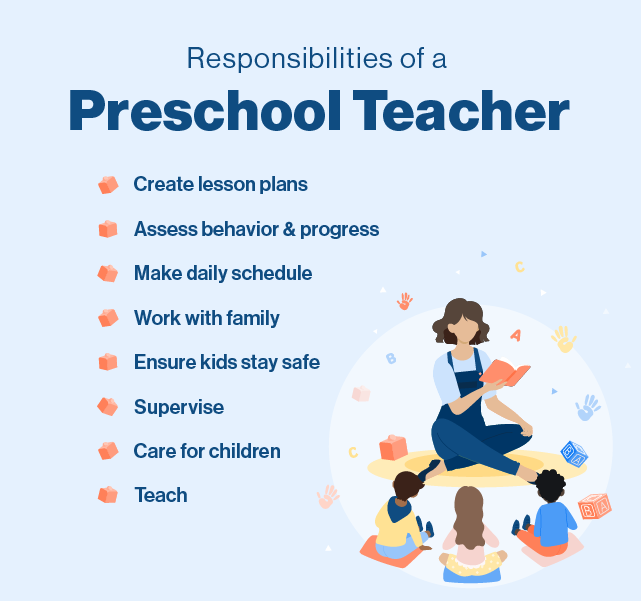
A preschool teacher is more than just a babysitter – they're responsible for ensuring children reach developmental milestones, develop social skills, and build a strong foundation for future learning in kindergarten and beyond. Normal duties for preschool teachers include
- Creating lesson plans. One big part of the job is creating lesson plans. Usually, a preschool teacher will create lesson plans after school hours, planning ahead for a week or a month at a time. A lesson plan usually involves different learning objectives and activities, and often dramatic play, that can help students develop important life and education skills.
- Assessing behavior and progress. Throughout the year, preschool teachers will assess the behavior and progress of their students. This is to make sure that students are meeting age-appropriate goals. Teachers will also be on the lookout for any developmental delays or learning issues that may hold the children back without intervention, including any socialization issues or learning disabilities.
- Working closely with parents or family members. Preschool teachers need to build a strong relationship with the parents of their students. They’ll regularly speak with parents about a student’s progress, struggles, and how to solve any issues that may arise.
- Provide basic needs. Preschool teachers will help students with basic needs, such as feeding them healthy snacks, making sure they have a nap, and helping them use the restroom and wash their hands.
- Making sure children reach developmental milestones. It’s very important that children reach certain developmental milestones and as a preschool teacher, you’ll be responsible for making sure they reach them. You’ll also want to make sure to note if they aren’t reaching them and mention it to the parents as it could be a sign of more long-term problems down the road.
- Teach foundational education skills. Preschool teachers start helping young children learn foundational things, such as counting, their numbers, and colors. They’ll teach these lessons through games, activities, and play.
- Supervising children at all times. A big part of being a preschool teacher is making sure the children aren’t left alone at any time. That means watching out while they play, do crafts, or nap.
- Providing structure through daily schedules. Part of your lesson plans will include daily schedules that you follow to create structure for the children you teach. That means having their morning snack at around the same time every day, a consistent nap time, and even scheduled play times.
- Ensuring the classroom is safe. Preschool teachers are responsible for maintaining a safe, clean environment so you’ll often clean your classroom and make sure everything is in working order.
Read more: The Busy Mom's Guide to Going Back to School
What is a typical day for a preschool teacher?
A typical day for a preschool teacher starts early. You’ll start your workday about a half hour to an hour before kids start arriving, depending on what your supervisor or the school owner asks of you. You’ll spend this time getting things organized and ready to go for the day. Preschools can have varying hours and may be connected to a daycare center. Daycare centers can open as early as 6:00am so parents can drop their children off before work, while a preschool will usually start the day around 7:30 to 8:00am.
After arriving at the school and getting set up for the day, morning drop-off starts! Parents will begin bringing their children in and leaving them in your care. You and your fellow teachers will make sure the children get settled and ready to start the day.
Once everyone is settled and ready to get started, you’ll jump into some morning activities that are designed to help the children wake up and be alert like stretching or dancing. After some morning lessons, you’ll move on to snack time. Generally, after the children have finished their snack, it’s playtime. Playtime is important for developing social skills, learning how to share, and learning coordination skills.
Then, the rest of the day usually includes lunch, nap time, more lessons, and more playtime before parents pick up their children in the afternoon.
Is becoming a preschool teacher a good career?
Becoming a preschool teacher can be a good career for many people. The job generally offers a decent entry-level salary and rewarding work. It’s also a great role for those who don’t want a job that is predictable; as a preschool teacher, every day brings something new as you work with children.
Read more: Top 11 In Demand Careers in Business, Tech, and Creative Fields
Is being a preschool teacher hard?
Being a preschool teacher can be hard but rewarding, depending on your personality. Just like any other job, it has its pros and its cons. Understanding the pros and cons of the job before you take the next steps can help you be more confident in your decision to become a preschool teacher.
The hardest part of being a preschool teacher is often working with the children, even though being able to help kids learn is why you’re interested in starting this career. While it is absolutely rewarding, and kids can be funny, smart, and sweet, they have their bad days just like anyone else. As their preschool teacher, you may have to handle those bad, tantrum-filled days while also juggling several other students. You’ll also have to interrupt fights, make sure everyone gets along, and hand out simple punishments for bad behavior as it arises. Added to that, you’ll regularly have to work closely with parents and guardians of your students, some of whom may be difficult or disagree with how you teach.
However, in early childhood education, the pros often outweigh the cons. As a preschool teacher, you’ll get to see children grow, help them learn, and form bonds that can make a difference in their lives going forward.
Read more: 6 Tips for Going Back to College or Career School as an Adult
How to become a preschool teacher (step-by-step)
1. Earn a high school diploma or GED
This is the minimum requirement for most entry-level childcare roles. You can generally find jobs in a daycare setting without a degree or necessarily even experience, but having education, training, and certification can help you earn more money. With just a high school diploma, you can qualify for daycare jobs like assistant teacher or classroom aide, which make an average of about $14 per hour.
2. Complete early childhood education training
Options include:
- Certificate programs (fastest path). This is generally more for someone who is already working in a daycare or childcare facility and wants to move up. The goal of certificate programs is to gain the 120 hours of education needed to earn your Child Development Associate (CDA) credential.
- Associate degree in Early Childhood Education. An associate degree can be most helpful for those who want to start in a teacher role without working their way up but don’t necessarily have work experience yet.
- Bachelor’s degree (for advanced roles). If you’ve already completed education, have work experience, and want to move up, the bachelor’s degree route could be a good fit.
3. Get required certifications
Not all jobs in the field will require certification but having credentials can help you stand out and earn more money. Common requirements can include:
- Child Development Associate (CDA) credential
- CPR and First Aid certification
4. Background checks and clearances
This can vary by state, but you may also be required to obtain positive background checks and clearances to be able to start work. For example, in Pennsylvania, someone who wants to work with children must have things like:
- Pennsylvania Child Abuse History clearance
- Pennsylvania State Police Criminal History
- FBI clearance (with fingerprints)
5. Meet state licensing requirements
Requirements vary by state and employer. Some positions require background checks and continuing education.
6. Health and safety
This can vary by state, but some may require you to have passed a physical exam and have a negative tuberculosis test within the last year.
7. Apply for preschool teaching jobs
Look for roles in:
- Private preschools
- Daycare centers
- Public school pre-K programs
- Head Start programs
After getting a job, you’ll need to regularly maintain your credentials and clearances. While you are often responsible for paying for those yourself before finding a job, some employers may be willing to cover the costs of renewal for employees.
Your CDA needs to be renewed every 3 years to be active and, depending on your state regulations, clearances and background checks need to be renewed every few years as well.
How long does it take to become a preschool teacher?
Becoming a preschool teacher typically takes 6 months to 5 years, depending on your education path. You can start in entry-level roles, like assistant teacher or daycare worker, with a high school diploma.
- Associate degree: ~2–3 years
- Bachelor’s degree: ~4–5 years
- Job search + background checks: a few weeks to a few months
Most background checks are completed within days, but FBI fingerprint checks can take up to 4 weeks.
Ready to Start a Career in Education?
What skills do you need to become a preschool teacher?
Preschool teachers and child care professionals need a few skills to be successful on the job. Besides understanding how to best teach children new information – something you can learn in an early childhood education or teaching degree – preschool teachers need skills such as
- Communication skills
- Creativity
- Patience
- Organizational skills
- Physical stamina
- Empathy
What are the benefits of being a preschool teacher?
The top reasons to become a preschool teacher include
- Making a difference in the lives of the children you work with
- Building relationships with your class and watching them grow
- Usually set work hours, Monday through Friday, when the school is open
- A fun work environment
- No two days are ever exactly the same, keeping work interesting
How much do preschool teachers make?
The average salary for a preschool teacher as of May 2024 was $37,120 per year or $17.85 per hour, according to the Bureau of Labor Statistics.
Where do preschool teachers work?
63% of preschool teachers work in daycare centers which can include nationally operated centers like Bright Horizons or KinderCare, non-profit centers operated by community organizations, and university or employer sponsored daycares.
16% of preschool teachers find work in educational services that are run by state, local, or federal governments. These could be facilities that are part of the public school system, Head Starts, etc.
15% will work for religious or civic organizations, so that includes childcare centers in churches or provided by organizations like the YMCA.
The smallest sector preschool teachers tend to work in is individual or family services. About 2% identify as working in these areas, which can include things like babysitting, home-run daycares, or nannying.
Can you become a preschool teacher online?
Yes, you can absolutely study to become a preschool teacher online. Online early childhood education classes can allow you to learn the important information and skills that can help you prepare to work with young children on the timeline that works best for you. Besides having a flexible schedule – generally, online classes can be done around your schedule and there are no deadlines or due dates – online degrees can often be much more affordable than traditional college programs.
When you’re researching early childhood education degrees to find the right one for you, you want to look for
- An accredited online college
- A program that can fulfill the 120 hours of education need for your CDA
- A program that incorporates hands-on training through observation and practical hours
What is Penn Foster’s Early Childhood Education Degree like?
Penn Foster’s online Early Childhood Education Associate Degree is a four-semester college program that consists of 63 credit hours. Each semester is self-paced, which means you can study, learn, take exams, and complete projects on the timeline that works best for your life.
Your early childhood classes will include subjects like
- Essentials of Psychology
- Fundamentals of Early Childhood Education
- Child Growth and Development
- Working with Children with Special Needs
- Guidance in Early Childhood Education
You’ll also take general education courses like English Composition and elective classes that include things like Family Childcare and Language and Literacy Development.
Besides your online classes, you’ll also have practical, hands-on experience. At a licensed childcare center near you, you’ll take part in observation and practical application hours. In your fourth semester, your fieldwork includes 300 hours total, making sure you spend at least 45 hours with each age group: infants, toddlers, and preschoolers. It’s a great way to build skills while working with kids of all ages!
Penn Foster doesn’t place students at daycares or childcare centers since we work with so many students across the country, so students will want to find a facility on their own. You’ll have guidance on how to find a site and what makes a good site as part of your courses.
What if you don't’ want to commit to a full degree?
If you don’t want to commit to doing a full early childhood education degree right now, but still want to work with children, you can also consider a few different options.
- Child Care Professional. While an associate degree is usually a minimum requirement to be a preschool teacher, you can still find other roles within a daycare or childcare center without a college degree. Our Child Care Professional Career Diploma, for example, can help you develop the basic knowledge and skills to work with young children while still getting the 120 hours you need to qualify for your CDA. This program can be completed in a shorter timeframe than the degree, but if you’re deciding between the two, you may be more likely to get a higher paying job with a degree versus the diploma alone.
- CDA Credential Prep. Already working in a daycare and want to get your CDA, but just need the 120 hours of education? Our CDA Credential Prep Undergraduate Certificate is designed to meet those education hours requirements while also helping you take the first steps toward building the portfolio you need to apply for your CDA. Like the other options, it fulfills education requirements but can potentially take less time to complete than doing a degree program.
- Child Psychology. Not necessarily looking to make a career change right now or just want to know a bit more about psychology? A child psychology course can be a quick way to learn new things that you can apply at home in your daily life or to work if you’re already in a job that deals with kids!
Become a preschool teacher online
If becoming a preschool teacher sounds like the perfect next career for you, you can take the first step toward your future job as soon as you’re ready. Just enroll online 24/7 or, if you have questions you can request more information. If you’d like someone to walk you through the enrollment process, our Admissions Specialists are available to help at 1-800-275-4410!