From Student to Veterinary Technician: A Step-by-Step Look at the Path from Training to Career

We follow strict quality and ethics policies to make sure our content is honest, accurate, and helpful. Learn more about our editorial guidelines.
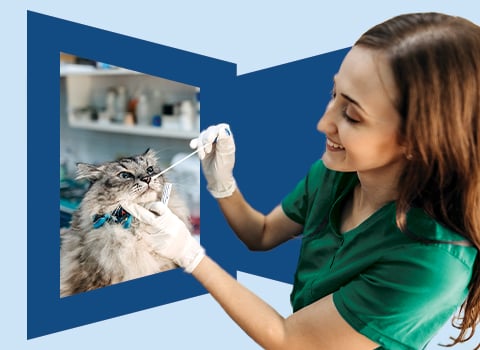
Credentialed veterinary technicians hold an essential role in the veterinary profession. They're skilled, compassionate professionals who truly can make a difference with the work they do. Because the work they do is technical and important, becoming a vet tech involves more than just applying for the job. Beckie Mossor, BIS, MPA, RVT and Director of Penn Foster's Veterinary Academy, had that realization in real time.
"The moment I knew this was my journey was on a day that I decided to get brave and apply for a job in a veterinary clinic," she said. "I walked in the back for the interview and the interviewer said, "don't worry, we will teach you how to use all this," referencing all the medical equipment. I remember in that moment realizing that if I wanted to do this, I would need formal education, not to learn on people's pets, but to go to school and learn what I needed to know."
But what does that journey really look like? How do you go from wanting to be a vet tech to actually doing the job?
Key takeaways
- Veterinary technicians need more than a love of animals, they also need medical knowledge, technical skills, emotional intelligence, and teamwork.
- Prospective vet techs should explore the realities of the job, including physical demands, stressful situations, and the emotional side of animal care.
- Choosing the right education program means considering accreditation, curriculum, externships, program format, and credentialing preparation.
- A consistent study routine and hands-on externship experience can help students connect coursework to real clinical skills.
- After training, graduates must review state-specific credentialing requirements, prepare for the VTNE when applicable, and continue learning throughout their careers.
What does a veterinary technician do?
A veterinary technician is a trained animal health professional who works alongside veterinarians to provide medical care, run lab work, and monitor patients in clinics, hospitals, and other animal care settings.
Being a credentialed veterinary technician requires a strong mix of medical knowledge and compassion. While caring about the well-being of animals is essential, having medical expertise to back up your skills is important. "Loving animals is often misconceived as the biggest part of our job, and honesty, it is one of the most important parts, the foundation," Beckie said, "but in order to be successful, and to make it in this profession, you have to like science and medicine, you have to have emotional intelligence, and the ability to work in a team."
As you're thinking about becoming a vet tech, your care and passion for animals can serve as the foundation when you take the next steps: formal training and education.
Read more: Is a Veterinary Career Right for You? 5 Questions to Ask Before Enrolling
The path to becoming a credentialed veterinary technician
The path to becoming a credentialed veterinary technician can take several years but allows you to build a necessary foundation of knowledge and hands-on training.
1. Explore the field and consider if it's right for you
While you may feel strongly that working in veterinary medicine is the path for you, it's important to take some time to really explore and understand what, exactly, the day-to-day of the job is like before committing to a degree program. Loving animals, again, is a great first step, but not everyone who loves animals will necessarily love the work environment or daily duties of being a vet tech.
Vet tech work is ultimately rewarding, but also can be a demanding career. Depending on where you work, you could find yourself on your feet all day, lifting heavy animals, dealing with the bodily fluids that happen in a medical setting, and working in a high-stress environment. As you're considering the job and whether it's the right fit for you, ask yourself a few questions.
- Are you comfortable with hands-on care and medical procedures?
- Are you able to remain calm and collected during high stress, emotional moments?
- Can you work well with people, as well as animals?
- Does continuous learning seem exciting to you?
It can also help to consider your life; what hours can you commit to working? Are you able to work longer days? Starting a career in veterinary medicine can feel intimidating because there's a lot to learn and the work you do can impact the health and well-being of your patients. But for those who are nervous or on the fence about whether veterinary medicine is the career path for them, Beckie had this to say:
"I think it's important to know that veterinary technicians are not people who wish we were veterinarians. A lot of people do go on to become veterinarians, but most of us chose the profession, the way that nurses are not people who wish they were doctors. So, it is important to know and understand the differences in the career and ensure you are coming to the profession for the right reasons. Next, I would ask what about the profession attracts you, and what scares you? And the last question is, what happens if you don't move forward or what would it mean to you to finish. Always follow your heart, you can do anything you put your mind to!"
Read more: The Difference Between a Veterinary Technician & a Veterinary Technologist
2. Choose the veterinary technology program that's the best fit for you
The next step is to research your education options. Look for things like:
- Accreditation. Not all college programs and schools will have the same accreditation. If you’re planning to be a credentialed veterinary technician and take the Veterinary Technician National Exam (VTNE), your best option is a program that is accredited by the American Veterinary Medical Association Committee on Veterinary Technician Education and Activities (AVMA-CVTEA).
- Curriculum. Make sure your classes align with AVMA standards and cover the material that will be important for the VTNE and on the job.
- Externship/practical training. Getting hands-on training allows you to practice what you learned in theory in real life. It’s also an important requirement for AVMA-CVTEA accredited programs.
- Program format. Consider whether you’re looking for an in-person format, where you attend scheduled classes or if a self-paced, online version is better for your life and schedule.
Penn Foster’s AVMA-CVTEA-accredited Veterinary Technician Associate Degree is one example of how these factors can come together in a veterinary technology program. The curriculum covers foundational topics such as anatomy and physiology as well as specialized subjects like surgical nursing and pharmacology. Its online, self-paced format can offer flexibility for students balancing school with other responsibilities, while two externships provide opportunities to practice AVMA-required skills at an approved clinic. These features may be relevant for both students entering the field and experienced veterinary professionals seeking the education needed for credentialing!
Read more: How Online Vet Tech School Helped Madison Take Control of Her Career
3. Build a study routine that fits your life
A strong study routine can make a big difference when you're balancing school, work, and life, especially in a self-paced program. "Create space in your schedule for school," Beckie advised. "We are all so busy and we think we can just "fit it in", but competing priorities can cause a lot of stress, and because of the convenience of self-paced study, it's easy to "get to it later". When you carve out the time in your schedule and stick to it, you can keep a pace for success!"
The time you carve out could be fifteen minutes during your lunch break at work, or a few hours every day; it all depends on what works best for you.
"One other really important thing students can do is to create a space for studying where you can stay organized and focused," added Beckie. Having a space that is blocked off just for your schoolwork can allow you to concentrate.
4. Complete an externship
Externships allow you to take what you learned in your classes and apply it to real skills and tasks in a veterinary clinic. You'll work with animals under the supervision of licensed veterinarians and credentialed vet techs to complete skills. In Penn Foster's Veterinary Technician Associate Degree, you'll have two externships to complete to graduate: one at the end of semester two and the other at the end of semester 4.
Each externship covers important skills that are relevant to working as a veterinary technician and give you experience in a clinical setting.
Read more: What to Know About Penn Foster's Vet Tech Externships (eBook)
5. The VTNE and credentialing requirements
After successfully completing your studies and externship, your next step is getting credentialed. Depending on where you live, that can involve a few different steps.
In most states, being credentialed is a requirement to work as a veterinary technician. You'll either be a certified, licensed, or registered vet tech once you meet all of your state's requirements. Part of that process is sitting for and passing the VTNE. Some states also have additional steps, including state-specific exams or licensing procedures.
The VTNE can be a tough test, but there are strategies for success. Beckie recently advised a Penn Foster Vet Tech student to study test-taking strategies. "There is a pattern and technique that can support knowledge when encountering a question you are not sure about," she said. "And here's the thing: it's just words. It's like working with a spicy cat, when you know the technique, you can get the job done, tests are no different, tame that exam and get it done!"
She also advises graduates take advantage of vet tech study platforms to help them prepare. "It can help you acclimate to the way that questions are worded on the exam and to gain confidence in jumping through different subjects and critical thinking through questions. They also can help a student gauge how prepared they are for the exam with practice tests."
With study strategies and formal education backing them up, our students have a three-year VTNE pass rate of 70.5%1, which is above the national average of 67.83%2!
Read more: How to Become Certified as a Vet Tech (State-by-State)
6. Find a job and keep learning
Once you've met your state's credential requirements, if any, you'll start your job search! After you've been hired, it helps to prepare for your first day, especially if it's the first time you're working in a veterinary clinic.
On your first day at work, you can likely expect to spend your time learning clinic routines, meeting everyone, and getting familiar with your role and its expectations. As you settle in, you'll start working with patients and putting the skills you learned in vet tech school to use! It can be scary at first, but remember to ask questions and always be open to learning.
Even Beckie, who is now a confident leader in veterinary education, was scared her first day, so don't feel bad if you're nervous! "My first day as a veterinary technician was scary, exciting, and all the feelings wrapped in one," she said. "But my education helped me feel confident in knowing my limits and what I needed to learn, where I excelled, and how to work in practice through my externship!"
As you grow in your vet tech career, you'll also be expected to keep up with current trends in veterinary medicine and take part in continuing learning opportunities. That could mean additional training, attending conferences, or taking online courses. Over time, you'll need to have a certain number of Continuing Education Units (CEUs) to maintain your credential as a vet tech. You'll generally need to renew your license, certification status, or registration about every two years, but the timeframe may vary based on your state's specific regulations.
Watch: Penn Foster College Grad, Jo, Pursues Vet Tech Dreams
The human part of veterinary technology
While your passion for animals set you onto this career path, being a vet tech also involves working closely with human clients. Besides caring for pets, you'll work with their owners to educate them on healthcare, help them through stressful decisions and emotional moments.
"Clients are under a lot of stress when they come to the clinic. They care about their pets so much and it can be scary for them when they don't know what is wrong with their pet, when their pet is sick or hurt, or fearing the worst after losing a pet previously. Clients need special handling and we need to develop the emotional intelligence to meet them where they are," Beckie shared.
Alongside your compassion for animals, understanding the needs of pet parents and providing support is an important part of the job. You're someone they trust to do the best for their pets, so your care and advice can mean a lot. That's not necessarily something you'll learn in school, but something you can develop over time through patience and practice.
Read more: Why Salary isn't the First Question Potential Vet Techs Ask
Celebrating our veterinary technicians
"I think what most people don't realize is that, in a lot of states, the people who are responsible for very serious and complicated procedures sometimes do them without formal training. And they don't understand the training involved with being a credentialed veterinary technician. Our education includes all the different things you find in a human hospital, radiology, phlebotomy, dentistry, ophthalmology, dermatology, surgery, anesthesia, orthopedics, and so on. On top of that, we learn these skills on all the species of animals, not just dogs and cats; we learn all of this for horses, cows, sheep, birds, pocket pets, and exotic animals! We have to demonstrate mastery of over 300 required skills to graduate and pass a national exam to become credentialed," Beckie said. Having that education is important to making sure you offer the best patient care possible to the animals you care for and reassure clients that their pet is in good hands! Through education, training, and dedication, credentialed veterinary technicians use their knowledge to make a difference every day and our veterinary clinics and hospitals wouldn't be the same without them.
If you're interested in doing work that makes a positive impact, learning about the role and exploring formal education can be a great first step to building a career you're proud of. Through a program like Penn Foster's online Veterinary Technician Associate Degree, you can take the next steps with a flexible, self-paced, accredited program that can help you build skills through classwork and hands-on training, all while preparing to sit for the VTNE. To learn more about how the program works, fill out this form and our dedicated Admissions Team will reach out to you directly! Or, if you know this is the right move for you, you can enroll 24/7 online and start learning the same day.
Frequent asked questions
What does a veterinary technician do?
A veterinary technician supports veterinarians with hands-on animal care, including running lab tests, taking x-rays, giving medications, and monitoring patients before and after procedures.
How long does it take to become a veterinary technician?
Most programs take about 18 months to 2 years, depending on the format and whether a student studies full-time or part-time. Credentialing requirements after graduation add additional time.
What happens during a veterinary technician externship?
An externship gives students hands-on experience in a real clinical setting so they can apply what they learned in coursework. It builds practical skills and confidence, though it is a learning experience rather than a guarantee of employment.
Do you need a degree to be a veterinary technician?
Most states require graduation from an accredited veterinary technology program and passing a credentialing exam. Exact education and licensing requirements vary by state or jurisdiction.
What is the VTNE?
The VTNE, or Veterinary Technician National Examination, is the credentialing exam used by most states to determine whether a graduate is ready to work as a veterinary technician. Requirements around the VTNE can vary by state or jurisdiction.
Is a vet tech career worth it?
It can be, if you want hands-on work with animals and don’t mind the medical, physical, and emotional sides of the job. It’s a rewarding career that allows you to make a difference! Getting started in the field does require dedication to learning and preparing for state credentialing requirements.
What are the pros and cons of being a vet tech?
The pros are being able to work with animals and have a job that makes a difference. You get to use knowledge in science and medicine to help pets. The cons can include long workdays, as well as physically and emotionally demanding work.
1 Based on Penn Foster VTNE test results from AASVB from January 1, 2023 – December 31, 2025.
2 Based on data obtained from the American Association of Veterinary State Boards in February 2026.