How Much Do Sterile Processing Technicians Make? An Honest Guide to Salary, Growth, and What Comes Next

We follow strict quality and ethics policies to make sure our content is honest, accurate, and helpful. Learn more about our editorial guidelines.
For many learners, salary is tied to something bigger than pay alone. The question is not only what the job pays today, but whether it can create better options over time. Penn Foster’s self-reported 2025 learner data found that 41% of learners enrolled in a program to increase their wages or pay.1 For someone looking into becoming a sterile processing technician, the potential salary can be a strong reason to choose this career path.
While you're evaluating your options, here's everything you need to know about sterile processing technician salary, how pay can vary and what factors impact your potential earnings, and how you can get started in this field!
Key takeaways
- Sterile processing technicians earn a mean annual wage of about $47,410, though pay varies by experience, location, employer, and work setting.2
- Specialty hospitals and outpatient care centers may offer higher earning potential than some other healthcare workplaces.
- Certification, such as the CRCST, can help candidates stand out and may support higher starting pay.
- Sterile processing can lead to advancement in leadership, education, compliance, instrument specialization, or other healthcare careers.
- The role is a strong fit for organized, detail-oriented people who enjoy behind-the-scenes healthcare work, but hospital schedules may include nights, weekends, holidays, or long shifts.
How much do sterile processing technicians make?
According to the most up-to-date U.S. Bureau of Labor Statistics, which collected data on salary in for the role in 2023, the mean annual wage for medical equipment preparers is $47,410, or about $22.79 an hour. Pay can vary by location, experience, employer, and work setting.
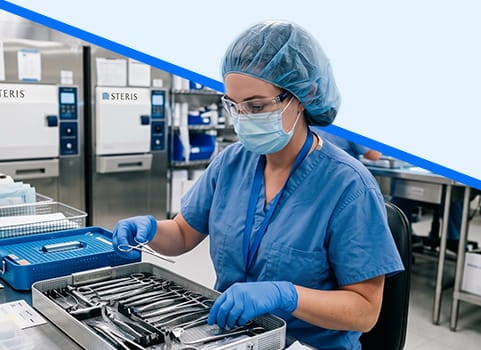
Medical equipment preparers sterilize, prepare, install, or clean lab or healthcare equipment. This could be standard equipment used in exams or even tools used for surgery. Depending on their exact role and job duties, they may also perform routine laboratory tasks and operate or inspect equipment. Medical equipment preparer is a broader term that can include multiple job roles, but sterile processing technicians fall under that umbrella.
Read more: What Does a Sterile Processing Technician Do?
What affects sterile processing technician salary?
Several things can affect your potential salary as a sterile processing technician including your experience, credentials, training, employer, and even where you live.
When looking for a sterile processing technician job, consider your experience, employer, and location to start. Entry-level positions may pay less, while hospitals and larger organizations often offer higher wages than physician offices or surgical centers. Pay can also vary by city and state based on cost of living and minimum wage laws. It's never a bad idea to check salary ranges in the job post or see if you can research typical salaries on sites like Glassdoor to get an idea of how much you can make. Besides knowing what the standard wage seems to be in your area, having a strong understanding of what people in the job are typically paid could allow you to negotiate your starting wage when you receive a job offer!
Read more: Sterile Processing Technician Program: Finish in Under 9 Months
How does sterile processing pay change with experience, location, or work setting?
Your employer and where you live can influence how much you can earn as a sterile processing technician. States with higher costs of living and more demand for trained sterile processing technicians can offer the potential for higher pay.
States with the highest pay for medical equipment preparers, including sterile processing technicians2
| State | Annual Mean Wage |
|---|---|
| California | $61,780 |
| District of Columbia | $58,830 |
| Alaska | $55,000 |
| New Jersey | $52,480 |
| Delaware | $52,450 |
Besides the state you live and work in, where you work as a sterile processing technician can change how much you can earn.
While most job openings for the role are usually found in hospital settings, some sterile processing technicians find work in places like dental offices, urgent care centers, outpatient care centers, and doctor's offices, and pay can vary greatly between each. For example, medical equipment preparers who work in specialty hospitals (think places that are dedicated to specialized or specific medical treatments like children's hospitals, cardiac hospitals, or orthopedic centers) tend to make an annual mean wage of $55,300 while those who work in general medical and surgical hospitals can make around $47,940.2
Medical equipment preparer salary by workplace2
| Workplace | Annual Mean Wage |
|---|---|
| General medical and surgical hospitals | $47,940 |
| Dentist offices | $36,020 |
| Outpatient care centers | $53,890 |
| Specialty hospitals | $55,300 |
Overall, a lot of factors can impact how much you can earn, but whatever your starting salary is, experience and additional training may open paths to greater responsibility over time.
Is sterile processing a growing career?
With an aging population and growing healthcare needs, it’s unlikely that the need for sterile processing technicians will decline soon. Besides getting your foot in the door of the healthcare industry, sterile processing can also offer opportunities for career advancement, either through advanced roles in the field or a transition to another medical profession.
What can sterile processing technicians do to advance their careers?
Sterile processing technicians can advance their careers over time, pursuing managerial or specialized roles in the field! The career path for sterile processing techs can go a few different ways, depending on what you're interested in and where your strongest talents are.
For those who want to stay within the sterile processing department, career advancement may mean moving into a leadership role, like lead or senior technician. Advancing into these kind of roles generally takes times and experience; as you build confidence in your skills and prove to be a dependable, strong employee, opportunities for getting ahead can start coming up.
Outside of advancing into leadership roles, sterile processing technicians can look into specializations that allow them to do different work. That could mean focusing on working with specific instruments or having the skills to prepare tools and space for more serious procedures.
Specializing may require further education, hands-on training, and certification.
A steppingstone to other healthcare careers
Sterile processing technicians don't just advance through the Sterile Processing Department; they can also use a sterile processing position as an entryway to other healthcare careers. For someone who is brand new to the industry, it can be a good way to get your foot in the door and learn about other jobs in the medical field. You’ll also likely have some transferrable skills, such as knowledge of medical terminology, that can help you prepare to transition to a different position.
If you want a patient-facing role, you could consider jobs like
- Surgical technologist
- Medical assistant
- Patient care technician
- Nursing
If you want to advance but still have a more behind-the-scenes role, you could move into roles like
- Health information management
- Medical registrar
- Surgical case-data coordinator
Whatever path you'd like to pursue, keep in mind that you'll usually need to get more training. Depending on the role, you may also need to get additional certification and even consider furthering your education. If you're working for an organization that offers education benefits or tuition reimbursement, you can even work with your employer to get this further training without necessarily having to pay for it yourself!
Read more: Sterile Processing Program Options for Career Changers (2026)
What additional training or credentials may be needed for advanced roles?
Entry-level sterile processing technicians can sit for the Certified Registered Central Service Technician (CRCST) Certification exam offered by the Healthcare Sterile Processing Association (HSPA) to get certified. For more advanced or specialized roles, you’ll likely need some additional credentials on your resume.
Typical advanced or specialized sterile processing certifications include:
- Certified Endoscope Reprocessor (CER). This certification is best for processing techs who want to move into instrument specialization.
- Certified Instrument Specialist (CIS). This certification can be a good fit for experienced sterile processing technicians who want to move into leadership or more advanced roles in the field.
- Certified Healthcare Leader (CHL). This certification is a good secondary credential to have for those who want to manage teams or departments.
Each certification requires work experience and a number of hours of hands-on training in specific skills. Depending on your employer, this is training that could be accomplished as part of your job, allowing you to learn more while still doing your regular tasks.
Besides hands-on training, you may also need specialized continuing education rather than going back to school for a full degree or training program. For sterile processing techs who want to move up, these continuing education courses can usually be found through dedicated professional organizations like the Healthcare Sterile Processing Association (HSPA) or even your own organization's career training programs.
Read more: 6 Tips for Going Back to Career School or College as an Adult
What should you consider beyond salary?
A career as a sterile processing technician can be a great fit for someone who enjoys following clear procedures, and making sure every step is completed correctly. If you’re interested in the behind-the-scenes work that keeps healthcare running safely, the role may be a fit.
The job also suits people who are dependable, patient, organized, and comfortable staying focused in a fast-paced environment. You don’t need to be highly outgoing or provide hands-on bedside care, but you do need to communicate well, work as part of a team, and speak up when something doesn’t look right.
Another thing to consider about the job is what kind of work schedule you need. Sterile processing technicians often have variable schedules, which may affect how you handle childcare or manage a second job. If you work in a hospital, you may work nights, weekends, and holidays, especially when you’re the newest member of the team. You might even have 12-hour shifts because of how busy hospitals get.
If a more predictable schedule is better for your life, then finding a job in a clinic, outpatient center, or doctor's office could be a better fit.
How Penn Foster can help learners prepare for a career in sterile processing
Penn Foster's online Sterile Processing Technician Career Diploma is designed to help you build fundamental skills in healthcare and sterile processing, while helping you prepare to sit for the CRCST certification exam.
With self-paced classes, you’ll learn how sterile processing technicians support patient safety, explore essential aseptic techniques and procedures, review HIPAA privacy regulations, and much more. You can study around your schedule and, depending on how much time you dedicate to your coursework, potentially complete the program in as little as two to four months.3
Throughout your program, you’ll have the support of dedicated instructors and staff to help you succeed in your online classes. While online learning is often independent, you can reach out for help and guidance through your Learner Center or by setting up an appointment to speak with an instructor one-on-one.
That support can help learners move forward with greater confidence. Ninety percent of surveyed alumni self-reported feeling more confident taking the next steps toward their goals, and 92% said they were proud they invested in themselves and their future.4
Once you complete your online classes, you’ll be eligible to sit for the CRCST exam, which is included in the cost of tuition. Although certification isn’t required in every state, earning a nationally recognized credential can help you stand out when applying for entry-level sterile processing jobs. In fact, 89% of healthcare employers said they would hire someone with a nationally recognized certification over someone without one, according to the National Healthcareer Association’s (NHA) 2026 Industry Report.5
After passing the CRCST exam, you’ll receive provisional certification. To become fully certified, HSPA requires you to complete and document 400 hours of work experience as a sterile processing technician within six months of passing the exam. While it feels like an extra step, these hours can be completed when you secure a job. Many healthcare employers have an understanding of the certification process, so finding support to complete these documented hours shouldn’t be a struggle!
Read more: 78,000 Learners Completed Penn Foster Programs Last Year. Here's Where They Are Now
What's the next step?
If you know sterile processing is the right career for you, the next step starts with researching trainings programs and finding the best fit for you and your schedule. You'll want to check out things like tuition costs and figure out whether or not the curriculum can help you prepare for the CRCST.
With Penn Foster College's Sterile Processing Technician Program, you can enroll and get started whenever you're ready! There are no due dates or deadlines to sign up and you can enroll online 24/7/365. If you want more information before getting started, you can also fill out this form and one of our Admissions Specialists will reach out directly to help you!
Sterile processing FAQs
How much does a sterile processing technician make? According to the BLS’s most recent data, sterile processing techs earn a mean wage of $47,410 a year. Actual pay depends on location, experience, and employer.
How do you become a sterile processing technician? Most sterile processing technicians complete a certificate or diploma program, then earn a credential such as CRCST to qualify for entry-level roles. Some employers also require on-the-job clinical hours before certification.
What does a sterile processing technician do? Sterile processing technicians clean, disinfect, and sterilize surgical instruments and equipment, then prepare and organize them for use in procedures. They play a key behind-the-scenes role in patient safety.
Is sterile processing technician a good job? It can be a solid entry point into healthcare. Training is shorter than for many clinical careers and the role can lead to advancement with additional certification or experience.
How long does it take to become a sterile processing technician? Most training programs take a few months to about a year to complete, depending on the format and pace, plus additional time to earn certification.
How do you get sterile processing technician certification? Certification (such as CRCST through HSPA) typically requires completing an accredited training program, passing a certification exam, and logging a set number of hours of supervised work experience.
Is sterile processing technician hard? The role isn’t physically demanding, but it requires attention to detail, knowledge of sterilization standards, and comfort following strict safety protocols. Most learners find it manageable with proper training.
Sources:
1 Based on data from a 2026 Learner Profile Survey which surveyed current learners current learners in all Penn Foster Group programs.
2 Bureau of Labor Statistics, U.S. Department of Labor. “Medical Equipment Preparers.” Occupational Employment and Wages. Accessed September 1, 2026.
3 With Penn Foster, you can learn at whatever pace works best for you. Some learners will be more comfortable moving faster, and dedicating more time, and the fast track estimate will apply to them. The average track will apply to most learners who can dedicate a few hours per week to completing their coursework. The estimated completion times are based on completion times for learners enrolled in this program from May 2021 - April 2022, excluding withdrawals.
4 Based on data from a 2025 Penn Foster Group End of Program survey of all programs.
5 National Healthcareer Association, 2026 Industry Outlook: How Allied Health Is Transforming the Healthcare Workforce (2026), PDF.